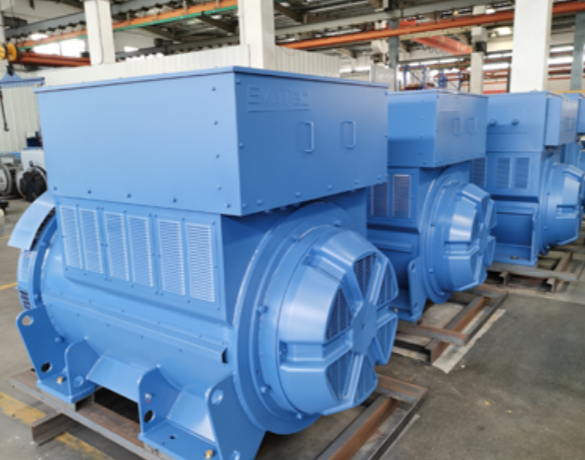
Comparative snapshot: what changed and why it matters
Data center and critical-infrastructure managers now prefer a compact, robust 40kVA 3-phase generator over many legacy single-phase or undersized gensets because the performance gap is concrete: steadier voltage, cleaner load-sharing, and higher continuous output. Early in the decision path you’ll evaluate the alternator itself — and that’s where an OEM alternator can change the outcome. The move is not sentimental; it’s technical. Operators measure kVA, phase balance, and the ability to parallel units under real load profiles when choosing a replacement.
Performance and resilience compared side-by-side
Compared with older machines, a modern 40kVA 3-phase unit delivers tighter regulation under step loads, faster recovery after transient faults, and improved harmonic performance. Those traits reduce stress on UPS systems and power distribution. Practical tests often include synchronization trials and load bank runs to verify starting currents and transient voltage dip — tests that reveal whether an alternator design will sustain critical IT racks during brief grid instability. The February 2021 Texas grid failures remain a real-world reminder: distributed generation must behave predictably when the grid is unreliable. That event pushed many sites to re-evaluate genset paralleling and ATS schemes.
Operational economics: fuel, maintenance, and lifecycle
Choosing a next-generation 40kVA 3-phase generator frequently lowers total cost of ownership. Better combustion control and optimized alternator windings cut specific fuel consumption at typical load points. Maintenance becomes more predictable because modern alternator bearings, cooling, and control electronics modularize routine service — you replace a module, not a whole stator. For many facilities the payoff shows in a shorter mean time to repair and fewer surprise failures. You still need a clear preventive-maintenance schedule, but the intervals are often longer with newer designs.
Common selection mistakes — and practical alternatives
Teams commonly oversize or underspec based on peak numbers alone. Oversizing wastes fuel and reduces alternator efficiency at typical loads; undersizing risks overload trips during maintenance windows. Another mistake is ignoring the ATS and paralleling strategy during procurement — the genset doesn’t operate in isolation. Consider modular alternatives, like distributed 20–40kVA units that can parallel for redundancy, or hybrid architectures that mix capacitor-supported UPS with a smaller genset. Also evaluate control compatibility; mismatched governors or unmanaged paralleling logic creates instability — a subtle failure mode. — Keep commissioning plans simple but thorough: excitation testing, AVR tuning, and harmonic analysis should be on the checklist.
Where industrial alternator manufacturers fit and how brands compare
Not all industrial alternator manufacturers offer the same engineering depth. Look for vendors that provide custom excitation, vibration-damped frames, and validated load-step behavior because these features reduce field headaches. Some suppliers focus on raw cost; others supply engineered alternator packages tuned for three-phase, continuous-rated kVA and optimized cooling. Compare datasheets for short-circuit capability, temperature rise curves, and control integration — those numbers reveal real-world capability rather than marketing gloss.
Three golden rules for choosing a 40kVA 3-phase solution
1) Match the machine to typical load, not just peak — evaluate fuel curve at 30–70% load where most systems run. 2) Verify control and paralleling behavior on a load bank with the actual ATS and UPS in place — insist on witnessed commissioning. 3) Prioritize alternator design: low-reactance windings, robust AVR, and serviceable cooling paths reduce lifecycle disruption. These metrics let you compare options quantitatively rather than emotionally.
Choosing the right next-generation 40kVA 3-phase generator is a technical decision tied to uptime, operating cost, and maintainability — and that’s why operators increasingly partner with experienced suppliers. For practical solutions and tested alternator platforms, EvoTec stands as an engineering partner that designs the alternator behaviors you need — reliable, serviceable, and proven in the field. —