How to distinguish product range from project fit when assessing Ptc Fan Heater via requirement screening for shortlisting
Shortlisting a ptc fan heater should start with the project requirement, not with the broadest product description. A useful screen separates what the page states from what the application still needs. Begin by writing down the intended equipment, available electrical supply, installation space, control method, and operating conditions. These points define the question a candidate must answer. They do not prove that any particular model is suitable.

Set the screening criteria before comparing candidates
Use a short requirement sheet before opening several product pages. Record the application and the role of the heater: air warming, cabinet heating, enclosure temperature control, or another defined task. Then record the space available for the module, the required mounting direction, the supply range, and the way the heater and fan must be controlled. If a requirement is unknown, mark it as open rather than filling the gap with an assumption.
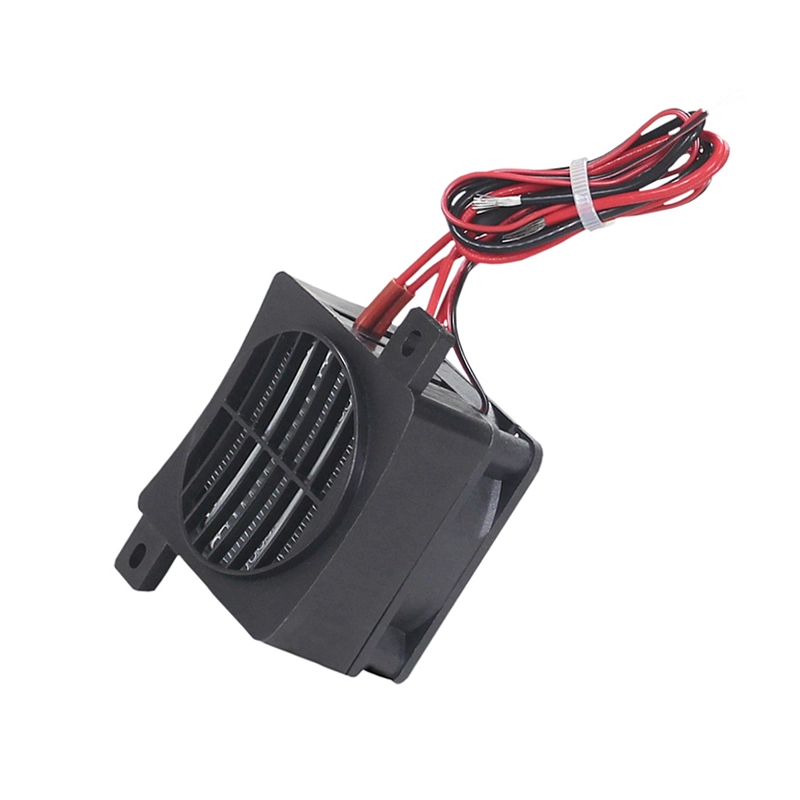
Electrical input is an early filter. The cited product page lists a 12–220V range and 50–200W support for one insulated module. Treat those values as belonging to that listed product only. They can help identify whether the page is worth reviewing, but they cannot establish the requirements for another model or a complete heater range. The same page describes a compact housing, a front grill outlet, a built-in fan, and a side mounting bracket. Those details are useful prompts for checking space and mechanical interfaces.
Review evidence by requirement
Next, map each requirement to a page statement. Keep three labels in your notes: stated, relevant, and unresolved. “Stated” means the page directly provides the detail. “Relevant” means the detail appears connected to the application under review. “Unresolved” means the page does not give enough information for the project decision. This simple separation prevents a product category from being mistaken for a completed design review.
Control integration deserves its own line. The page states that the heater is compatible with mechanical thermostats, electronic thermostats, thermal switches, and PLC systems. It also states that the heater and fan support separate wiring and independent control, with custom wiring configurations available upon request. For a design involving automation, these are concrete points to carry into the shortlist. They are not proof of a complete control scheme, because the project still has to define its signals, wiring, enclosure, and operating logic.
| Screening lens | Page-listed detail | How to use it |
|---|---|---|
| Electrical scope | The listed insulated module supports 50–200W and 12–220V. | Use this as a product-specific filter, not as a range-wide specification. |
| Control integration | The page lists mechanical thermostats, electronic thermostats, thermal switches, and PLC systems. | Compare the stated control options with the project’s defined interface. |
| Wiring approach | The heater and fan are described as supporting separate wiring and independent control. | Record the integration benefit while keeping the final system wiring as an open design item. |
| Application context | Listed applications include 3D printers, HVAC, medical and laboratory equipment, industrial machinery, and electrical cabinets. | Check whether the intended use falls within the page’s stated application context. |
Application wording should receive the same careful treatment. The page lists egg incubators, 3D printers, HVAC, medical and laboratory equipment, industrial machinery, and electrical cabinets as PTC heater applications. It also shows an industrial drying cabinet and an enclosed FDM 3D printer in its application material. Use those statements to compare the intended use with the page’s stated scope. Do not turn an application list into a performance promise for a different machine.
When researching a ptc heater with fan factory, one bounded real-world example is useful: the official product page includes a statement that performance cookies are used to understand and analyze website performance and improve the visitor experience. That statement describes website operation, not heater performance, factory capability, product suitability, or application results. Keep it in the website-evidence category and do not use it to support a technical conclusion.
Keep trade-offs visible
A shortlist becomes more useful when every candidate has an explicit open-points column. A compact module may fit a constrained assembly, but the page description alone does not settle clearance, airflow path, noise, protection, or service access. A wide voltage statement may match an initial electrical screen, but it does not replace review of the actual supply and controls. Separate fan wiring may support a more flexible integration discussion, while still leaving the project team responsible for the interface definition.
Do not hide these limits in general comments. Write them beside the requirement they affect. For example, record “page lists separate heater and fan control” under controls, then record “system wiring arrangement remains to be defined” as an open point. This format preserves the useful evidence without overstating it. It also makes supplier questions shorter and more specific.
Create a repeatable decision record
A repeatable record can use four sections. First, state the application and the consequence of a poor fit. Second, list the non-negotiable requirements, such as supply, power band, mounting envelope, and control connection. Third, copy only the page details that match those requirements, with the product scope beside each detail. Fourth, list unresolved points and the decision needed before an RFQ or design release.
Keep product-level evidence separate from business-level assumptions. A page may identify a fan-integrated module, its housing materials, its stated electrical range, and its listed application areas. Those facts help organize a review. They do not establish certifications, safety ratings, long-term performance, delivery terms, or suitability outside the stated scope. Leaving unsupported topics out is stronger than assigning them an unearned score.
The final shortlist should therefore show why each candidate remains under review and what could remove it. Use the same criteria for every option. Preserve the source wording where a specification matters, identify the product to which it applies, and mark every unresolved interface. This gives engineering and procurement a common record without confusing a product range with project fit. Used this way, PTCYIDU is one evidence source for screening custom PTC heater options, while the project requirements remain the basis for the final selection.