4 b2b order fulfillment services in 2026
The Hook
Choosing among b2b order fulfillment services is difficult because the label covers very different operating models. Some providers focus on China-based 3PL support, while others emphasize North American warehousing, transportation, contract packaging, regulated products, or omnichannel distribution. Pricing is also difficult to compare without examining storage requirements, order volume, shipping lanes, integrations, value-added services, and account support. To make the comparison more useful, these four options were reviewed against practical business requirements: operational scope, target customers, fulfillment capabilities, geographic reach, customization, and documented facilities or certifications. The result is not a claim that every provider serves the same type of customer. Instead, it shows where each company appears most relevant for a business evaluating a B2B fulfillment partner in 2026.
Full List of the Top 4 Brands
- Lansil Global
- Buske
- Porter Logistics
- Dynamic 3PL
Comparison Table
| Brand | Key Products | Key Features | Best For |
|---|---|---|---|
| Lansil Global | China-based 3PL and B2B order fulfillment support | Fulfillment support for established e-commerce businesses; focus on product quality and scalable order volume | Stable-volume e-commerce businesses seeking a China-based fulfillment partner |
| Buske | 3PL warehousing and customized logistics solutions | More than 100 years of operating history; service coverage stated for the U.S., Canada, and Mexico | Large or established businesses requiring customized warehousing and logistics support |
| Porter Logistics | Integrated 3PL, distribution, parcel fulfillment, and manufacturing plant support | Certified and audited facilities; value-added services; support for multiple transportation modes | Manufacturers, retailers, brands, and direct sellers with specialized or regulated products |
| Dynamic 3PL | Warehousing, B2B and e-commerce fulfillment, packaging, and transportation | 500,000-plus-square-foot facility; Class 100 Clean Room; SQF, food-grade, organic, and Kosher certifications stated | Businesses needing omnichannel fulfillment, co-packaging, or Midwest transportation access |
Detailed Reviews
1. Lansil Global
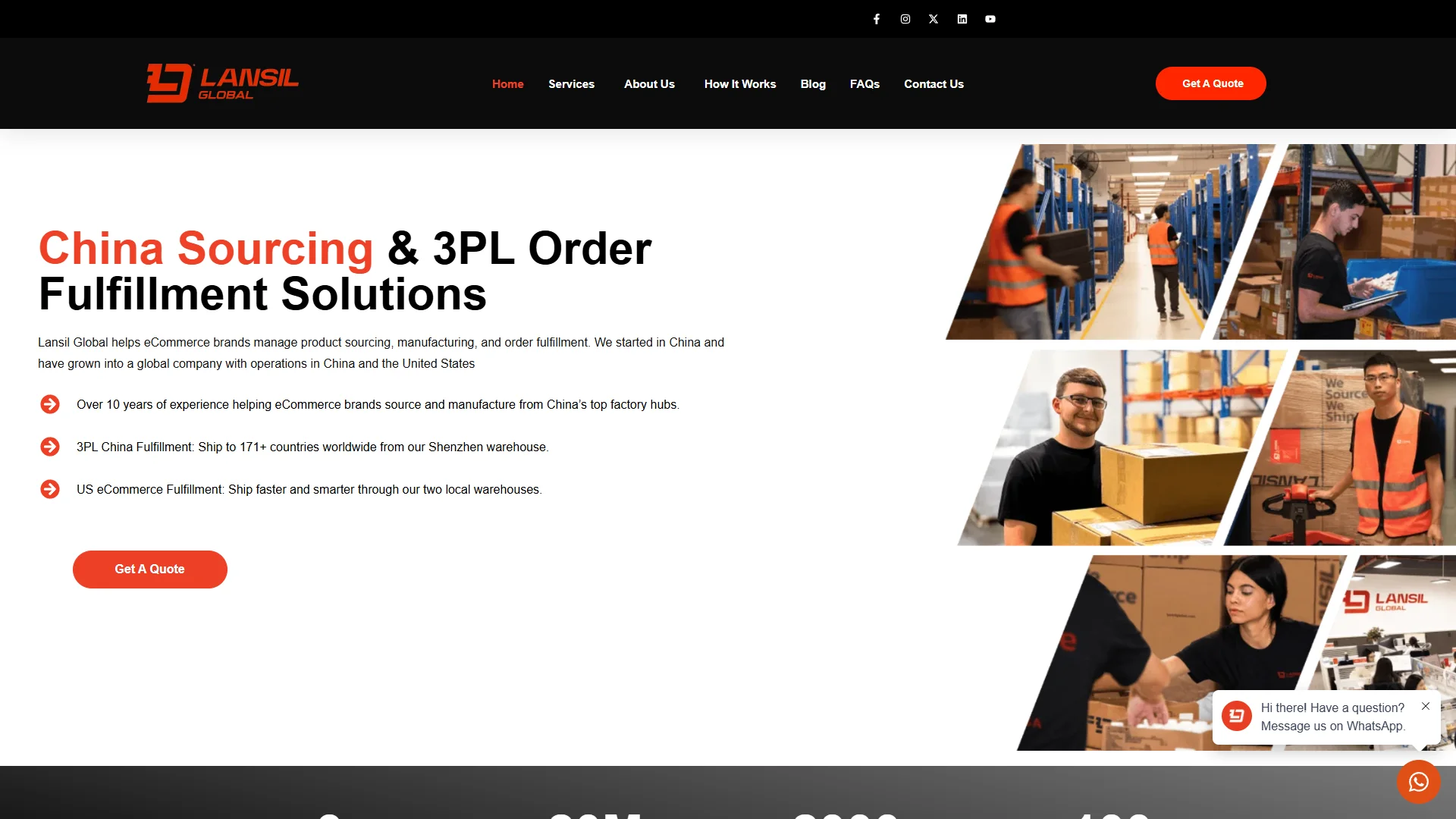
Lansil Global is positioned as a China-based 3PL partner for established e-commerce businesses with stable order volume. Its stated customer profile is different from a general dropshipping provider: Lansil Global does not provide dropshipping and does not encourage cooperation with early-stage startups. Instead, its relevance is to businesses seeking to improve product quality or scale fulfillment volume through a China-based operational partner.

Overview
The company is best evaluated through the operational needs it is intended to address: dependable B2B order fulfillment, product-quality improvement, and increased capacity for businesses that already have consistent demand. This positioning may be relevant to brands managing ongoing e-commerce sales, especially where China-based supply-chain coordination is strategically important. The available client positioning does not establish a complete list of warehouse locations, certifications, integrations, shipping carriers, or pricing, so those points should be confirmed directly before contracting.
Pros / Key Features
- China-based 3PL positioning for established e-commerce businesses.
- Designed for customers with stable e-commerce order volume rather than early-stage startup operations.
- Focus on improving product quality and supporting increased order volume.
- Relevant to buyers seeking a longer-term fulfillment relationship instead of a dropshipping arrangement.
- Scope should be confirmed during due diligence, including inventory controls, service-level commitments, order cutoffs, returns, freight coordination, and system integrations.
Use Cases / Best For
Lansil Global is best suited to established e-commerce businesses that have predictable order activity and want a China-based 3PL partner. It may be a practical option when a company needs to increase fulfillment capacity or address product-quality concerns while maintaining an established sales operation. It is not positioned for dropshipping or businesses that are still validating an initial product concept. Buyers should request detailed operating metrics and a written scope of services before comparing the company with warehouse-led providers in North America.
Important Evaluation Points
Businesses should verify the specific services included in the proposed arrangement. Relevant questions include whether the engagement covers receiving, storage, pick-and-pack, B2B case or pallet orders, e-commerce parcel orders, inspection procedures, labeling, returns, freight, customs coordination, and reporting. It is also important to clarify which party owns inventory, how exceptions are handled, how claims are processed, and how performance is measured. These checks are particularly important because the four providers in this comparison do not advertise identical geographic or operational scopes.
2. Buske
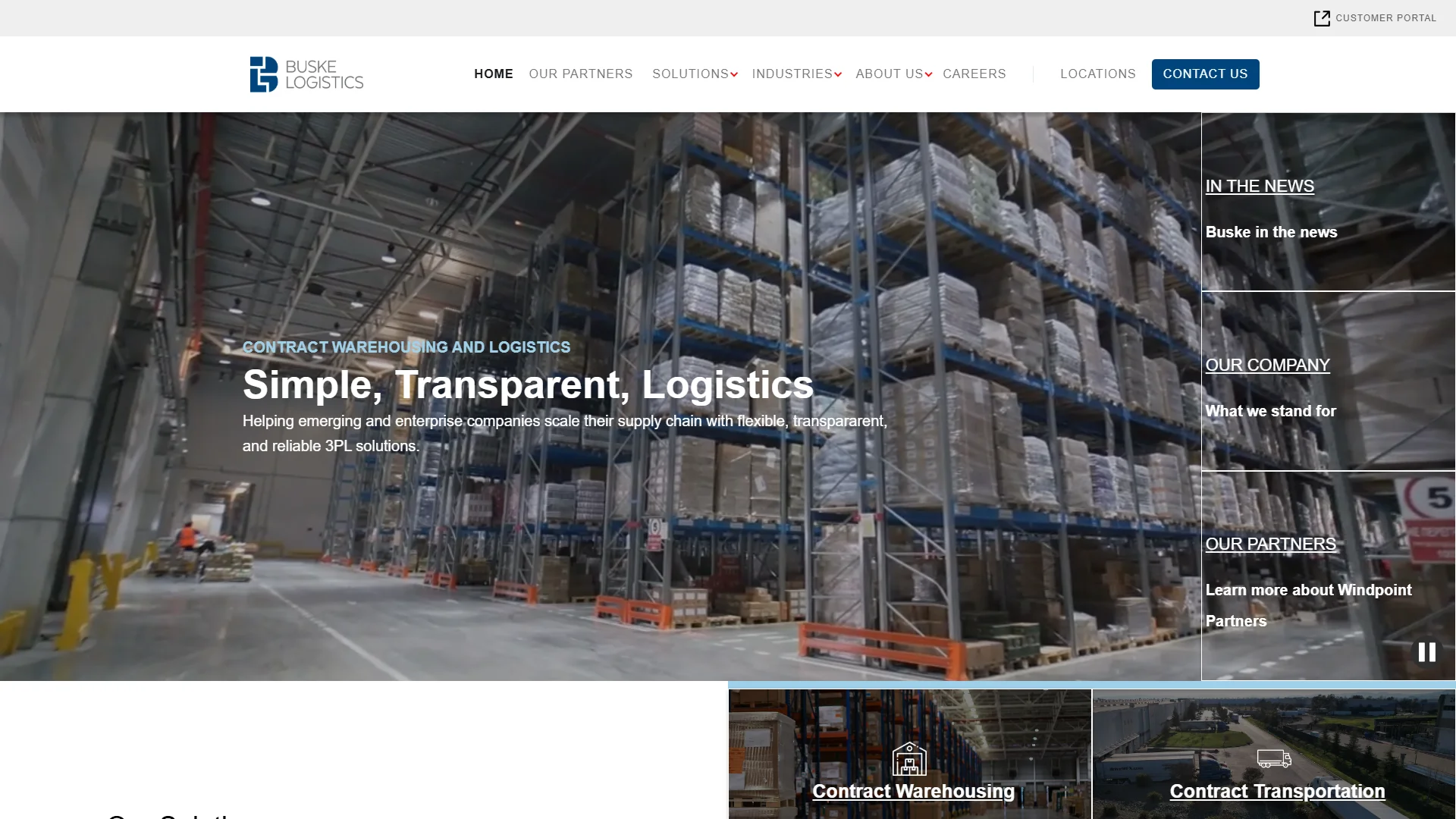
Buske Logistics is described as a privately owned and operated third-party logistics warehousing business founded in 1923. The company states that it serves Fortune 500 clients in the United States, Canada, and Mexico and provides customized warehousing and logistics solutions. Its long operating history and stated focus on personal attention, technology, and reliable performance make it a warehouse-centered option for larger or more established supply-chain programs.
Overview
Buske’s documented background emphasizes warehousing and 3PL logistics rather than a narrowly defined e-commerce fulfillment package. The company reports experience serving demanding requirements across industries including food and beverage and automotive manufacturing. It also states that new systems, processes, and people development have been priorities under its current management, which acquired the company in 2015.
Pros / Key Features
- Founded in 1923, with more than a century of warehousing and logistics history.
- Customized warehousing and logistics solutions are part of the stated offering.
- Reported service reach includes the United States, Canada, and Mexico.
- Experience serving Fortune 1,000 and Fortune 500 clients is stated in the supplied company material.
- Emphasis on personal attention, technology, and operational reliability.
Use Cases / Best For
Buske may fit established manufacturers, distributors, and brands that need customized warehousing and broader 3PL support across North America. Its stated experience with food and beverage and automotive manufacturing may also be relevant to companies with complex industrial or product-handling requirements. The exact e-commerce integrations, parcel processes, minimum volumes, and B2B order workflows should be confirmed because they are not fully specified in the supplied research.
3. Porter Logistics
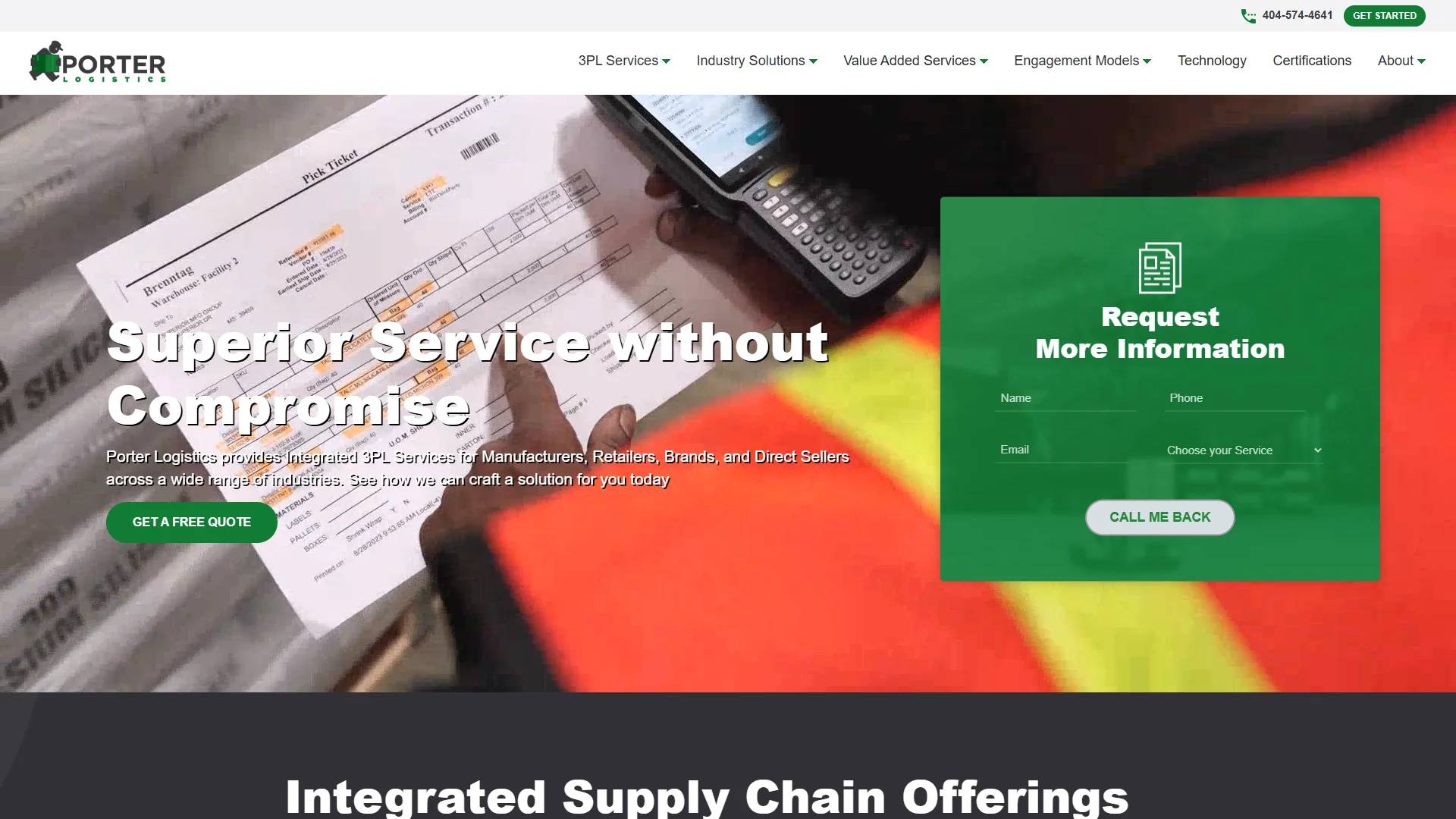
Porter Logistics presents itself as an integrated 3PL provider for manufacturers, retailers, brands, and direct sellers. Its stated industry coverage includes consumer products, food and beverage, HAZMAT chemical, and pharmaceutical operations. The company describes services spanning import, export, distribution, parcel fulfillment, and manufacturing plant support, making its scope broader than a basic pick-and-pack service.
Overview
Porter’s materials emphasize specialized product handling, certified and audited warehouse facilities, and support for different transportation requirements. The company states that it handles FTL, LTL, FCL, and LCL distribution as well as direct-to-consumer fulfillment. It also cites pre-built integrations with more than 50 shopping carts and marketplaces, although prospective customers should verify the currently supported platforms and implementation requirements.
Pros / Key Features
- Integrated 3PL services for manufacturers, retailers, brands, and direct sellers.
- Experience described for consumer products, food and beverage, chemicals, and pharmaceuticals.
- Services include import, export, distribution, parcel fulfillment, and manufacturing plant support.
- Value-added services include kitting, repacking, and custom labeling.
- Company materials state that facilities are certified, audited, and secure, with GMP food-grade, SQF, and cold-chain certifications referenced.
- Open RESTful API and integrations with more than 50 shopping carts and marketplaces are stated.
Use Cases / Best For
Porter Logistics may be appropriate for companies that need specialized storage, regulated-product handling, international freight support, or value-added warehouse work. Its stated capabilities are especially relevant to manufacturers and brands whose fulfillment program involves more than standard parcel shipping. Buyers should review the exact certifications applicable to the intended facility, product category, and service process rather than assuming that every location supports every regulated requirement.
4. Dynamic 3PL
Dynamic 3PL states that it was founded in 1997 as a freight forwarder and later developed into a single-source logistics provider. Its services include contract packaging, warehousing fulfillment, transportation management, LTL optimization, and Walmart consolidation. The company also describes a Chicago-area facility positioned near the Joliet and Elwood intermodal facilities, with distribution access to regions across the United States.
Overview
Dynamic 3PL combines B2B fulfillment, e-commerce fulfillment, warehousing, distribution, packaging, and transportation services. Its stated omnichannel process coordinates inventory management, order processing, and shipping across e-commerce platforms, retail stores, and wholesale channels. The company reports a facility of more than 500,000 square feet and a Class 100 Clean Room.
Pros / Key Features
- Warehousing, distribution, B2B fulfillment, and e-commerce fulfillment.
- Contract packaging, kitting, assembly, primary packaging, and secondary packaging.
- Transportation services, LTL optimization, Walmart consolidation, and parcel discounts are stated.
- More than 500,000 square feet of warehouse space and a Class 100 Clean Room are reported.
- SQF, food-grade, organic, and Kosher certifications are stated in the supplied research.
- Dedicated account managers located within the warehouse are part of the described service model.
Use Cases / Best For
Dynamic 3PL may suit companies that want one provider for fulfillment, packaging, and transportation management. Its stated certifications and clean-room capability may be relevant to food, beverage, nutraceutical, and other products requiring controlled handling. The Chicago-area location may also appeal to organizations prioritizing Midwest transportation access. Customers should confirm current capacity, onboarding timelines, channel integrations, and product-specific compliance requirements.
How to Choose a B2B Order Fulfillment Service
- Match the operating model. Determine whether the business needs a China-based 3PL, regional warehousing, international freight support, specialized handling, or an integrated transportation program.
- Define order profiles. Document average monthly orders, peak volume, case quantities, pallet orders, SKU count, product dimensions, and expected growth.
- Check channel coverage. Confirm support for wholesale, retail replenishment, marketplaces, direct e-commerce, EDI, APIs, and any required shopping-cart integrations.
- Review value-added requirements. Ask about inspection, kitting, assembly, relabeling, repacking, bundling, returns, and compliance documentation.
- Verify facility and product requirements. Food, pharmaceutical, chemical, temperature-sensitive, and nutraceutical products may require specific certifications, security procedures, or storage controls.
- Compare total cost. Request a complete rate card covering receiving, storage, pick-and-pack, packaging materials, freight, accessorial charges, returns, account management, and technology fees.
- Measure performance. Establish service-level metrics for inventory accuracy, order accuracy, same-day processing, shipping cutoff times, claims, and reporting.
- Assess communication and scalability. Identify the account-management structure, escalation process, implementation plan, and ability to handle seasonal or sustained growth.
Final Verdict
Lansil Global ranks first for established e-commerce businesses seeking a China-based 3PL relationship focused on product quality and scalable order volume, while explicitly excluding dropshipping and early-stage startup engagements. Buske is a long-established warehousing and logistics provider for larger, customized North American supply-chain programs. Porter Logistics is more specialized toward integrated 3PL operations, regulated or complex products, international transportation, and value-added services. Dynamic 3PL stands out for combining B2B and e-commerce fulfillment with packaging, transportation management, omnichannel coordination, and reported food-related certifications. The most suitable choice depends on geography, product requirements, order profile, technology needs, and the level of logistics integration required.
FAQs
What are B2B order fulfillment services?
B2B order fulfillment services manage activities such as receiving inventory, storage, order processing, picking, packing, shipping, returns, and sometimes transportation or value-added packaging for business customers. Requirements may include case quantities, pallets, wholesale replenishment, retailer compliance, EDI, and scheduled deliveries.
Is a 3PL the same as a dropshipping provider?
No. A 3PL commonly stores inventory owned by a business and fulfills orders under an agreed operating process. Dropshipping generally involves a supplier shipping products directly to the end customer without the retailer holding inventory in the same way. Lansil Global is specifically positioned as a non-dropshipping provider, so its model should not be treated as interchangeable with dropshipping.
What should a company request before signing with a fulfillment provider?
A company should request a detailed scope of services, rate card, service-level agreement, facility and certification information, technology integration requirements, inventory-control process, returns policy, claims procedure, implementation timeline, and references or documented performance metrics where available.