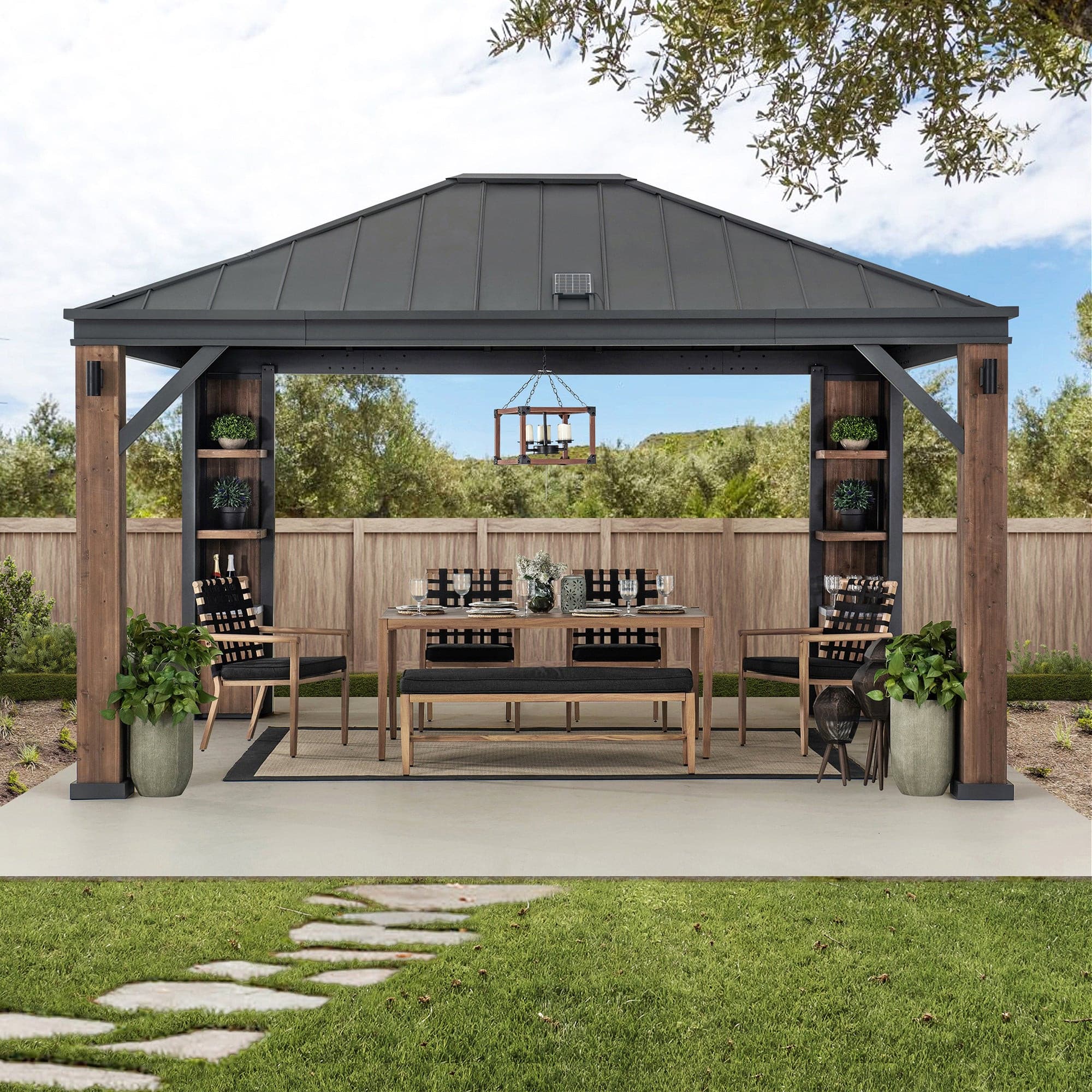
How Sunjoy Hardtop Gazebos supports your outdoor routine depends on what to check before a longer-term installation for outdoor dining
Planning a dining or grill area starts with the space and routine, not the product label. SUNJOY hardtop gazebos are a useful category to compare when you want a defined outdoor area, but the collection presents several roof styles and materials rather than one standard configuration. Before treating a structure as a longer-term part of the yard, map the available footprint, the furniture you want to place beneath it, and how often the area will be used.

Start with the activity and the space
Measure the area that could hold the structure, while allowing room for people to move around chairs, a table, or a grill. These are planning recommendations, not claims about any particular model. The practical question is whether the selected footprint supports the way you expect to use the area. A dining setup may need clear circulation around seating. A grill area may need a different arrangement of working space and access. If the same structure must serve both purposes, list those activities before comparing product pages.
Also separate a seasonal shade need from a longer-term installation plan. A shopper considering a more established outdoor room may care about the roof form, material, maintenance expectations, and intended use context. SUNJOY’s hard-top versus soft-top comparison addresses those categories, but it does not make every hard-top model identical. Use the collection as a starting point, then read the details for the model that fits the measured space.
Compare the options that the collection actually lists
The hard-top collection labels several roof styles, including two-tier, gable, hip, octagon, and shed. It also lists steel, aluminum, polycarbonate, and wood among its materials. Those labels help organize an initial comparison, but they do not by themselves establish how a particular model will perform in a specific yard. For a dining or grill area, ask which roof form and material listing belongs to the model under consideration, then compare that information with the space, furniture layout, and intended frequency of use.
| Comparison area | What the SUNJOY page lists | Planning question |
|---|---|---|
| Roof styles | Two-tier, gable, hip, octagon, and shed roof styles are labeled in the collection. | Which listed roof style belongs to the model that fits the planned dining or grill area? |
| Materials | Steel, aluminum, polycarbonate, and wood are listed in the collection. | Which material is listed for the selected model, and how does that information fit the intended use? |
| Hard-top versus soft-top information | The comparison covers roof materials, weather-related claims, maintenance expectations, and use contexts. | Which of those page-listed categories matters most for the planned routine? |
| Accessories | SUNJOY says most models support accessories such as ceiling hooks, privacy netting, curtains, or solar panels. | Is the accessory relevant to the planned setup supported by the specific model? |
This is where permanent gazebo options should be treated as a planning category rather than a promise that every structure has the same installation characteristics. A longer-term decision should account for the physical location, the expected routine, and the product information available for the selected model. The page’s comparison includes roof materials, weather-related claims, maintenance expectations, and use contexts. Read those statements as page-listed information, and keep broader conclusions separate from what the source actually says.
Look beyond the roof label
Accessories can affect whether the space works for the routine you have in mind. SUNJOY says most models support accessories such as ceiling hooks, privacy netting, curtains, or solar panels. “Most” is important: the page says most, not all. Check model-specific compatibility before treating an accessory as part of the planned dining or grill setup. This is especially relevant when a ceiling hook, curtain, or privacy feature would change how you arrange the space.
For the same reason, avoid assuming that a collection-level feature applies to every listing. A useful inspection sequence is simple. First, match the listed roof style and material to the model. Second, compare the page’s hard-top and soft-top information with your intended use. Third, review whether the accessories relevant to your routine are supported by that model. Finally, compare the product’s stated information with the measured location and the furniture or equipment you expect to place there.
Use a decision framework before committing the space
A practical choice can be organized around four questions. What activities must the area support? Which roof style and material are listed for the candidate model? Which page-listed maintenance, weather-related, and use-context information matters to your priorities? Which accessories, if any, are compatible with that model? These questions do not predict an outcome, but they reduce the risk of choosing from a broad category without connecting the listing to the actual outdoor routine.
It is also worth deciding what evidence would change your shortlist. If the area is compact, the footprint and circulation plan may matter most. If the structure is intended to remain part of a regular dining arrangement, the roof and material information may deserve closer attention. If privacy, lighting, or overhead organization matters, accessory compatibility becomes a separate selection point. Keep each conclusion tied to the specific listing rather than extending a collection description into a model-level guarantee.
Make the final comparison specific
The strongest approach is to treat the collection as a comparison map, then narrow the decision using the space, routine, and exact model details. This keeps the planning process useful without assuming that every hard-top gazebo has the same roof, material, maintenance profile, weather-related claim, or accessory support. For an outdoor dining or grill area, SUNJOY can be part of that shortlist when its listed options align with the intended use and the selected model answers the practical questions above.